
NanoMixer
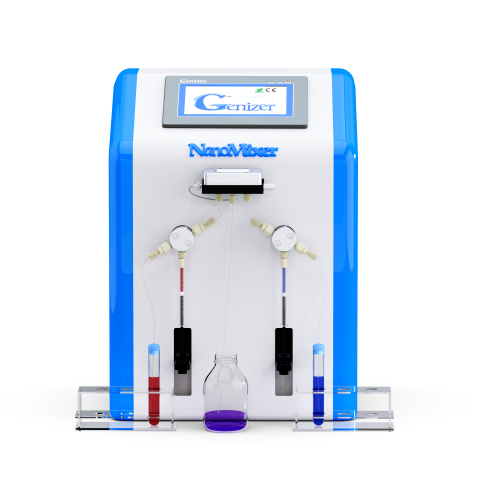
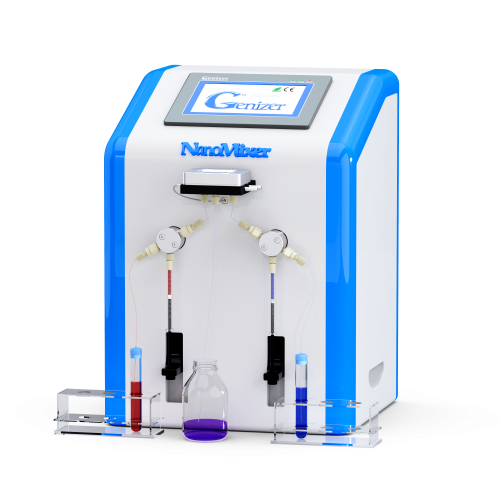
Laboratory Microfluidics Mixer for mRNA/DNA lipid/polycation nanoparticle preparation (max. pressure 500 psi)
Each NanoMixer model is equipped with independent syringe pumps, a PLC control system, and mixing modules that ensure reproducible and uniform formulation. With a working pressure up to 500 psi and temperature tolerance up to 80°C, the system supports sterile, dead-volume-minimized mixing suitable for sensitive biopharmaceutical applications.
Nanoemulsions and liposomes
Fat emulsions
Cell disruption and nanoparticle suspensions
Multi-component formulation development
Modular Design: Available in 2, 3, or 4-pump configurations for dual, ternary, or quaternary blending (A+B, A+B+C, A+B+C+D). The quaternary pump configuration also supports continuous microfluidic blending of A+B by allocating two pumps for continuous feeding of component A and two pumps for component B.
Compact and Lightweight: Integrated design (70×36×30 cm, 20–35 kg) suitable for benchtop use
Thermal Tolerance: Up to 80°C (176°F) for formulation stability
Digital Interface: Pressure display or analog pressure gauge options
Easy Cleaning: Flush-to-clean system
Compliant: CE and RoHS certified
Specifications
| Catalog No. | NanoMixer | NanoMixer-Triplex | NanoMixer-Quad |
| Flow Rate | 0-10mL/min | 0-10mL/min | 0-10mL/min |
| Min. Sample | 1mL | 1mL | 10mL |
| Max. Pressure | 500psi A+B=AB |
500psi A+B=AB+C=ABC |
500psi A+B=AB A+B+C=ABC A+B+C+D=ABCD |
| Dimensions(cm) | 70 × 36 × 30 | 70 × 36 × 30 | 70 × 36 × 30 |
| Weight | 20 kg (44 lbs) | 30 kg (66 lbs) | 35 kg (77 lbs) |
| Max. Temp. | 80ºC (176ºF) | ||
| Power | 110V/220V | ||
| Cleaning | Flush to clean | ||
| Application | mRNA/DNA/siRNA delivery systems, Nano emulsion, fat emulsion, liposome, cell disruption, nano dispersion, microsphere | ||
| Features | Digital display of pressure and flow rate | ||
Features
| Channel | Y-type Microfluidic Mixing Chip AB-Y; ABC-Y; ABCD-Y | ||
| Control System | High pressure programming control systems: touch screen, speed control, auto stop control by volume, time, pressure or temperature, settable volume control as low as 0.2mL, display of flow rate and time, overload protection | ||
| Pressure Gauge | Digital display on the touch screen | ||
| Inlet Type | Luer | ||
| Outlet Type | Luer | ||
| Inlet Reservoir | 1mL gas tight syringe | ||
| Outlet Reservoir | 10mL Tube | ||
| Product Material | 316L stainless steel, tungsten carbide, viton, teflon | ||
| Material Standard | Sanitary grade, FDA, GMP | ||
| Warranty | 1 year against any manufacturing defects | ||
| Option Features | |||
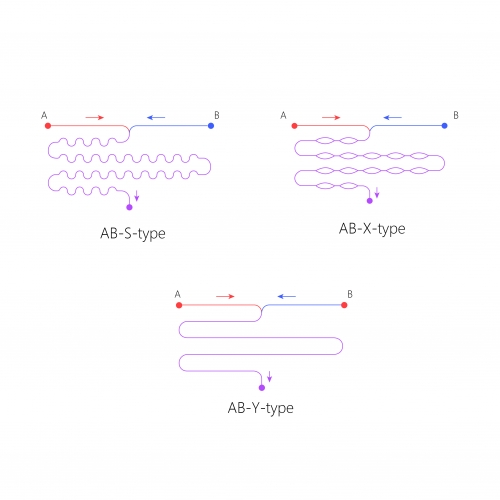
| Channel | NanoMixer Y-type (Single Line) Microfluidic chip: AB-Y; AB-YT; NanoMixer S-type (Single strand like RNA) Microfluidic chip: AB-S; AB-ST; NanoMixer X-type (Duplex strand like RNA) Microfluidic chip: AB-X; AB-XT; NanoMixer-Triplex Y-type (Single Line) Microfluidic chip: ABC-Y; ABC-YT; NanoMixer-Triplex S-type (Single strand like RNA) Microfluidic chip: ABC-S; ABC-ST; NanoMixer-Triplex X-type (Duplex strand like RNA) Microfluidic chip: ABC-X; ABC-XT; NanoMixer-Quad Y-type (Single Line) Microfluidic chip: ABCD-Y; ABCD-YT; NanoMixer-Quad S-type (Single strand like RNA) Microfluidic chip: ABCD-S; ABCD-ST; NanoMixer-Quad X-type (Duplex strand like RNA) Microfluidic chip: ABCD-X; ABCD-XT; T: Heating/cooling jacket with built-in temperature sensor; |
||
| Control System | Please send the drawing if you need customized Microfluidic Chip | ||
| Detector | Pressure gauge, pressure transducer, temperature transducer | ||
| Outlet type | Tri-clamp or luer | ||
| Heat Exchanger | Heating/cooling jacket with built-in temperature sensor | ||
| Inlet Reservoir | 2.5mL, 5mL, 10mL gas tight syringe | ||
| Outlet Reservoir | 2.5mL, 5mL, 10mL, 50mL, 100mL tube or gas tight syringe, S/S cylinder, jacketed glass cylinder or online | ||
| Cylinder | Titanium high pressure cylinder (resistant to strong acid and base) | ||
How to Use
FAQs and Tips
Troubleshooting:
Mechanical Faults
1.Backflow at Inlet
Symptom: Liquid flows back at the inlet while the syringe is in the extrusion stroke.
Cause: The inlet check valve has failed.
Solution: Replace the check valve.
2. Backflow at Outlet
Symptom: Liquid flows back at the outlet while the syringe is in the suction stroke.
Cause: The outlet check valve has failed.
Solution: Replace the check valve.
3. Microfluidic Chip Microchannel Blockage
Symptom: Sudden rise in internal system pressure causes connected capillaries to detach due to high pressure.
Cause: The microchannels on the chip surface are blocked.
Solution: Clean the chip microchannels.
4. Insufficient Suction Due to Air in Tubing
Symptom: The syringe does not fully fill, and air is present in the liquid.
Cause: Air is trapped inside the tubing system.
Solution: To degas the system, push the liquid upward in the syringe while loosening the outlet check valve to release trapped air.
Once the liquid flows steadily, tighten the valve, and repeat this process two to three times until all air is expelled.
Electrical Faults
1.Red Power Switch (PWR) Not Lit
1) Check if the fuse is blown; replace if necessary.
2) Check the device power connection; reconnect if faulty.
3) Check the wall socket; ensure the plug is fully inserted.
2. Clicking “Start” on the Main Interface Has No Response
1) Turn off the power and wait 30 seconds before restarting.
2) The system will rebuild, which takes a few seconds.
If the problem persists after restarting, contact after-sales service for assistance.
Equipment Maintenance
1. Repair and Preventive Maintenance
The required frequency of repair and preventive maintenance depends
on usage and the specific applications performed.
It is generally recommended to schedule maintenance and preventive
servicing at least once per year. Adhere to the recommended maintenance intervals.
If any component fails, it is recommended to replace it immediately to
prevent further damage to the system. Following these guidelines will help maximize the system’s service life.
2 Daily Cleaning
The syringe holder and chip bracket are the most common areas for spills, droplets, and material buildup. Surfaces can be wiped with ethanol or isopropanol. If fluid flows along the syringe holder into the interior of the instrument, there is no need to stop the machine during operation because the system is designed with a dry-wet separation; small amounts of liquid will not affect safety. After stopping the instrument, wipe the area with a clean, lint-free cloth. If fluid splashes onto the plastic housing, wipe it promptly to keep the exterior dry and avoid damage to the paint.
To clean the instrument body, cover, and all internal components, wipe surfaces with any of the following:
a. Warm water with a mild, non-abrasive detergent
b. Ethanol
c. Isopropanol
Use a soft cloth to wipe the surfaces, avoiding scratches that could affect the appearance of the instrument.