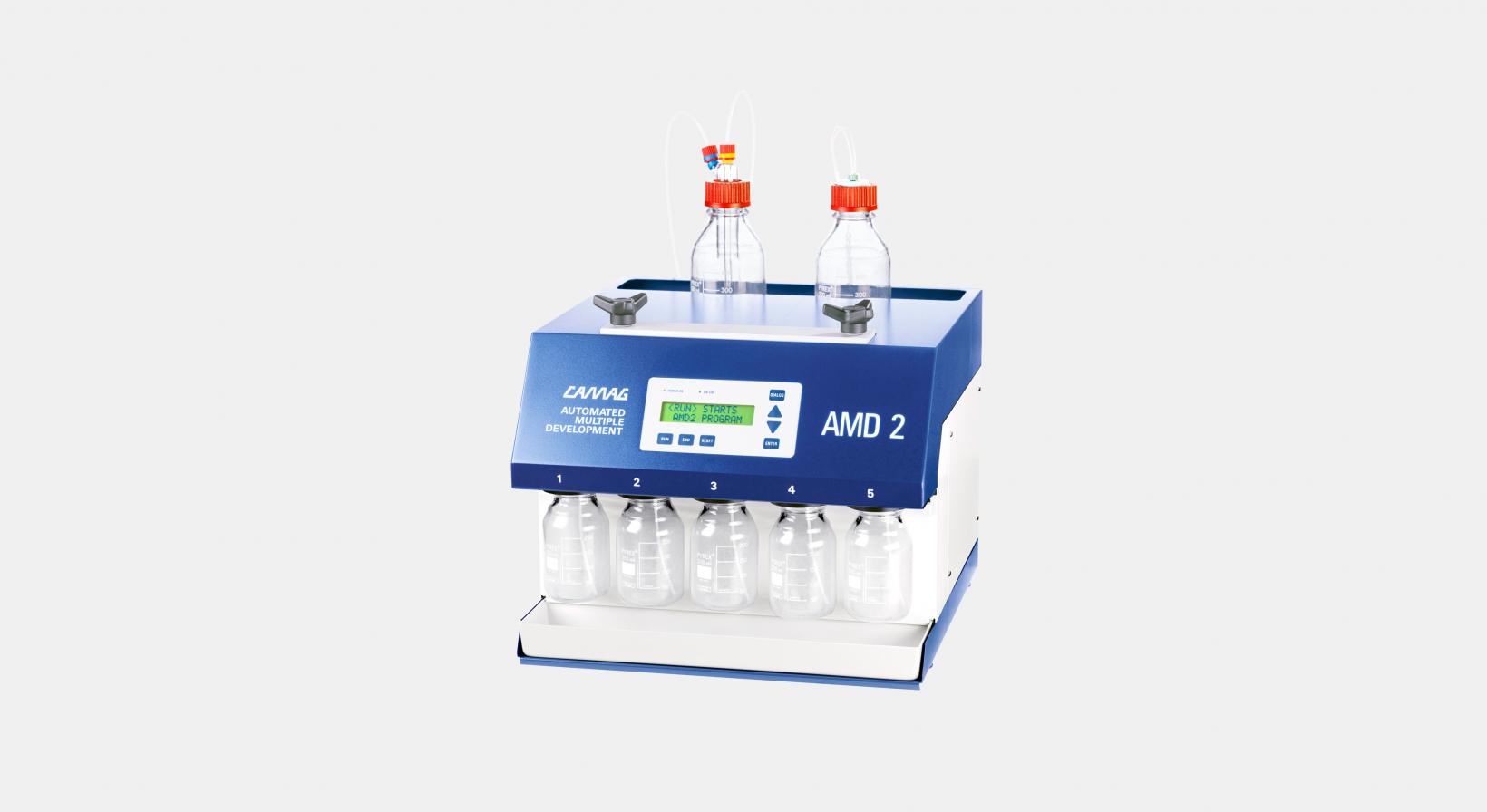
AMD 2 System Automated Multiple Development
The AMD 2 is a software-controlled HPTLC chamber for gradient development. It is used for difficult separation problems that cannot be solved by isocratic HPTLC.
The separation of complex samples is a challenging task for every chromatographic system, particularly when the sample components span a wide polarity range. The AMD procedure offers an excellent solution as it allows stepwise gradient elution over increasing separation distances. As a result acid, bases, neutral, hydrophilic, and lipophilic substances can be separated in a single AMD run.
This makes AMD suitable for a variety of applications. The technique is frequently used in lipid analysis and in routine analysis of drinking water. Pigment formulations with a complex composition, resins as well as additives of mineral oil products are other typical applications of AMD analysis.
Key Features:
- Multiple development
- Stepwise gradient elution over increasing separation distances
- Enhanced separation capacity
- HPTLC glass plates (20 x 10 cm), only
- Software-controlled with visionCATS
The principle of the AMD procedure
- The HPTLC plate is developed repeatedly in the same direction
- Each successive run extends over a longer solvent migration distance than the one before
- Between runs, the solvent is completely removed from the developing chamber and the layer is dried under vacuum
- Each successive run uses a solvent of lower elution strength than that of the one used before. In this way, a stepwise elution gradient is formed
- The combination of focusing effect and gradient elution results in extremely narrow bands. Their typical peak width is about 1 mm. This means that, with the available separation distance of 80 mm, up to 40 components can be completely resolved, i.e. with base line separation
- With visionCATS the AMD 2 can be IQ/OQ qualified and used in a cGMP environment. Operated with the mentioned software, the AMD 2 supports compliance with 21 CFR Part 11.